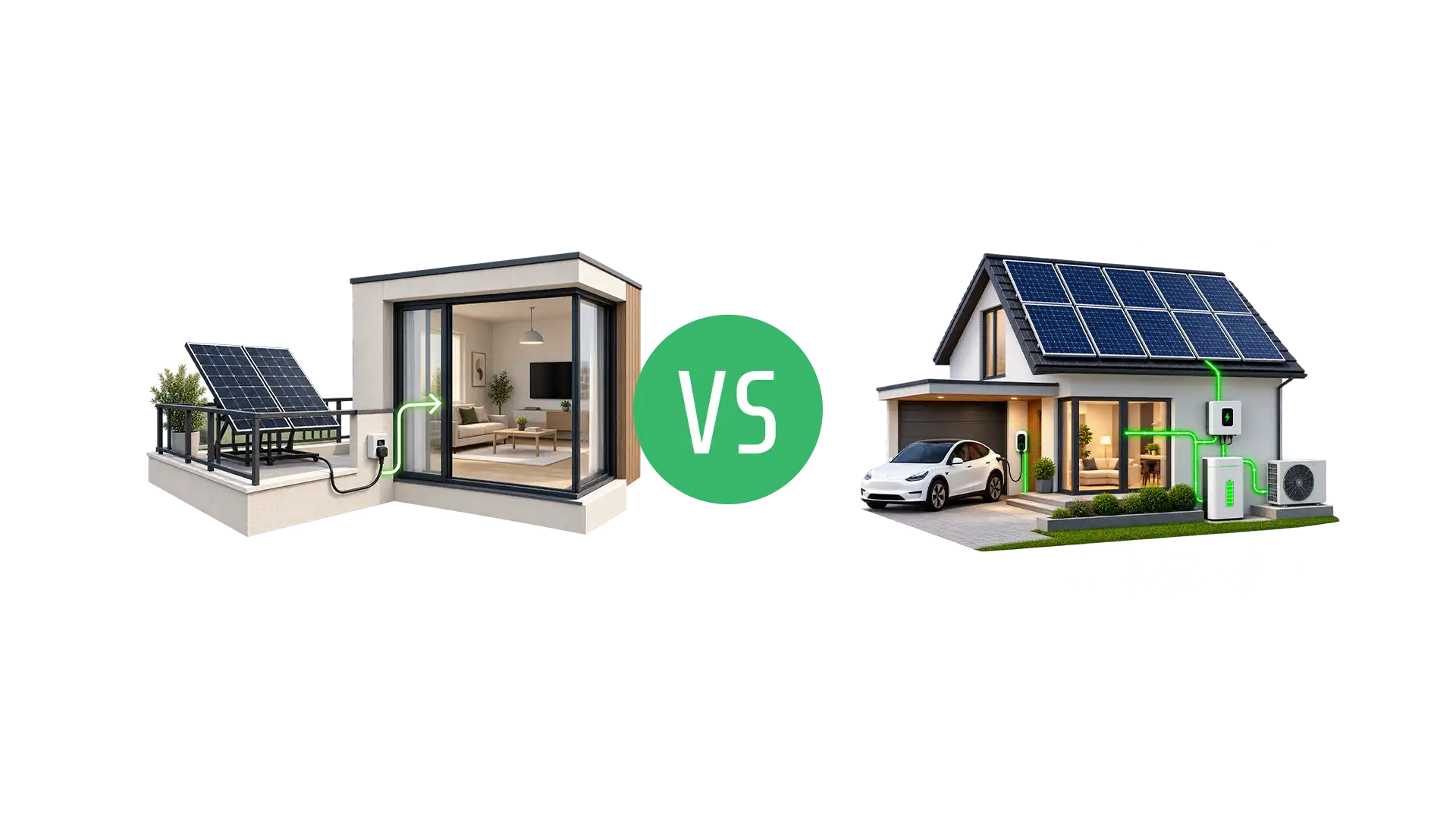
Plug-In Solar vs Rooftop Solar: What UK Homeowners Need to Know in 2026
Solar energy has just become more accessible to UK households.
From 27 August 2026, approved plug-in solar systems can legally be bought and used across Great Britain, allowing homeowners to generate electricity from small solar panels connected directly to a suitable household socket. The new plug-in solar framework applies in England, Scotland and Wales. Northern Ireland has separate electricity connection rules and is not currently covered by these changes.
It is an exciting development, particularly for people who may previously have been unable to install traditional rooftop solar. But it also raises an obvious question:
If you can now buy solar panels and plug them into a socket, do you still need a professionally installed rooftop solar system?
The answer depends on what you want solar to achieve.
Plug-in solar and rooftop Solar PV both generate renewable electricity, but they are designed for very different levels of energy use. Understanding those differences can help you decide whether you simply want to reduce some of your daytime electricity consumption or whether you are looking to build a wider home energy system.
What is plug-in solar?
Plug-in solar — sometimes called balcony solar or plug-and-play solar — is a small-scale solar system designed to be more accessible than traditional rooftop PV.
A typical system includes one or more solar panels, a microinverter that converts the electricity into a form your home can use, and a manufacturer-supplied cable that connects the system to a suitable socket. A microinverter that converts the electricity into a form your home can use, and a cable that connects the system to a suitable socket.
Under the new rules, a compliant plug-in solar can feed up to 800W of power into a home.
The UK Government estimates that this could provide up to around 20% of an average household's electricity use and potentially save a household up to £110 per year, depending on the property, system and how the electricity is used.
For households unable to install rooftop panels, that could make renewable energy accessible for the first time.
Plug-in panels might, for example, be positioned on a suitable balcony, terrace, shed or other outdoor area rather than covering a home's roof.
Who could plug-in solar work well for?
Plug-in solar could be particularly useful for people who:
live in flats or apartments with suitable outdoor space
rent their property and have the necessary permission
don't have a suitable roof for a conventional solar installation
want a relatively low-cost way of generating some electricity
want to reduce part of their daytime grid electricity consumption
aren't currently ready to invest in a larger home energy system.
This is why we don't see plug-in solar as something that should automatically be compared negatively with rooftop solar.
It is simply a different scale of solution.
For some households, small-scale solar may be exactly what they need.
For others, particularly those looking at battery storage, EV charging, electric heating or wider smart-home technology, rooftop PV offers considerably more scope.
Plug-in solar vs rooftop solar: what's the difference?
One of the most important differences is the amount of electricity the systems are designed to generate.
Plug-in solar systems are currently limited to up to 800W.
A professionally designed domestic rooftop solar array will typically have several kilowatts of generation capacity, depending on available roof space, orientation, energy requirements and system design.
That makes the two solutions fundamentally different.
Plug-in solar is primarily about offsetting part of your electricity consumption.
A larger rooftop PV installation can potentially become the foundation of a much broader home energy system.
For example:
Plug-in solar
Solar panels → electricity used within the home
Whole-home energy system
Solar PV → battery storage → home → EV charger → heat pump → smart energy management → grid
Once you begin looking at solar in this way, the question becomes less about the panels themselves and more about how your home generates, stores and uses electricity.
Does plug-in really mean “just plug it in”?
This is an important point.
Although the technology has been designed to make small-scale solar much easier to access, a solar system feeding electricity into your home is not quite the same as plugging in an ordinary electrical appliance.
Traditional household electrical systems have primarily been designed around electricity travelling from the electrical installation to appliances.
Plug-in solar introduces electricity back into that circuit.
The Institution of Engineering and Technology (IET) has therefore advised homeowners not to automatically assume that every existing electrical installation will be suitable.
It recommends that consumers consider having their electrical installation assessed by a competent electrician before buying or connecting a plug-in system, particularly where there is uncertainty about the condition or type of existing protection.
Why does the existing electrical installation matter?
Modern homes contain electrical safety devices such as Residual Current Devices (RCDs), designed to disconnect electricity rapidly when certain faults occur.
However, electrical installations vary enormously.
Some properties have modern consumer units and wiring, while others may contain systems installed many years ago.
The IET points out that simply having an RCD doesn't automatically confirm that an electrical installation is suitable for plug-in solar. Different types of protective devices behave differently, and the wider condition and configuration of the home's electrical installation matters too.
So although plug-in solar makes generating renewable electricity simpler, it shouldn't mean ignoring the electrical system behind the socket.
Don't use an extension lead to connect plug-in solar
Another important distinction is how the equipment should be connected.
Plug-in solar systems should normally connect directly to an appropriate socket, following the manufacturer's instructions and applicable guidance.
They shouldn't simply be connected through whatever extension lead or multiway adaptor happens to be available.
In research commissioned by the IET, almost one in four respondents said they might use an extension lead or multiway adaptor if a solar system's cable didn't reach a suitable socket.
The IET specifically warns that doing this where it isn't intended could introduce additional electrical safety risks.
If the most suitable location for your solar panels doesn't have an appropriate socket nearby, having the correct electrical provision installed is a much better approach than improvising the connection.
Product quality matters too
Not every solar product available online will necessarily offer the same level of quality.
A UK Government safety study tested representative plug-in solar systems under a range of simulated domestic conditions and found that systems could operate safely within the conditions tested.
However, the study also identified variation between products, including differences in areas such as export limitation and electromagnetic compatibility. The findings highlighted the importance of clear product standards and consumer guidance as the UK market develops.
That means homeowners should pay attention not only to price, but also to product approval, manufacturer reputation, instructions and suitability for the UK market.
What happens to the solar electricity you don't use?
This is where the difference between simply generating some solar electricity and designing a complete home energy system becomes much more important.
Solar panels generate electricity when daylight is available.
But your home doesn't necessarily use most electricity at exactly the same time.
You might generate strongly during the middle of the day while nobody is home, then consume considerably more electricity during the evening.
With a larger professionally designed system, battery storage can help capture more of that energy for use later.
Instead of the journey ending at:
Solar → Home
it can become:
Solar → Home or Battery → Use Later
And once battery storage enters the picture, there are even more possibilities.
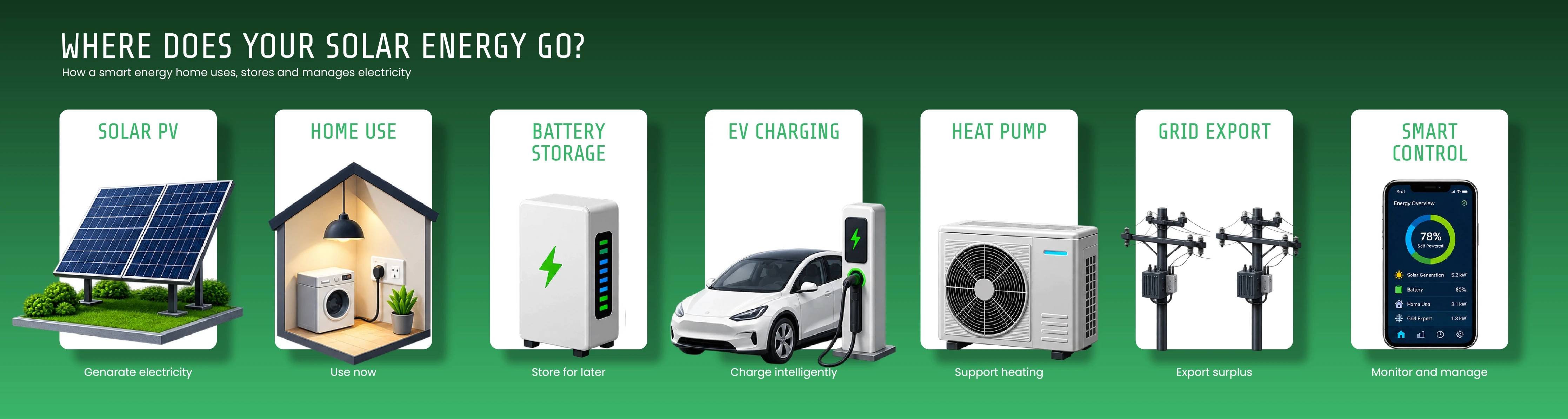
Solar and battery storage
A home battery can store energy generated by your solar panels rather than requiring it to be used immediately.
That stored electricity might then be used later in the evening, when solar generation has reduced or stopped.
Depending on the system, tariff and setup, batteries can also potentially be charged using lower-cost grid electricity during selected periods.
That changes the way we think about solar.
Instead of simply asking:
“How much electricity will my panels produce?”
a better question becomes:
“How can my home make the best use of the energy available to it?”
For households considering products such as Sigenergy battery storage, solar is therefore only one component within a much broader energy ecosystem.
Add an EV and things become even more interesting
An electric vehicle can be one of the largest electrical loads in a modern home.
If you already own an EV — or expect to buy one in the future — it makes sense to consider that when planning your solar and electrical system.
Solar generation, battery storage and EV charging can potentially be designed to work alongside each other rather than being treated as three unrelated installations.
The same principle applies if you're considering an EV charger now but solar later.
Planning the wider requirement from the beginning can help create a system that is more appropriate for how the property will actually use electricity in the years ahead.
What about heat pumps?
Heat pumps bring another major electricity demand into the home.
Traditionally, heating and electricity have largely been thought about separately.
As homes move towards technologies such as:
Solar PV
battery storage
EV charging
air source heat pumps
smart tariffs
home automation
those boundaries begin to disappear.
Your heating system, car, battery and solar installation can all become part of the same energy picture.
And this is where smart energy management becomes increasingly valuable.
From solar panels to a smart energy home
Solar panels can generate electricity.
But a truly smart energy system considers how and when the electricity available to your home should be used, stored, imported or exported.
Imagine a home capable of understanding:
how much electricity the solar array is producing
how much power the house currently needs
how much energy is stored in the battery
whether the EV needs charging
when electricity from the grid is cheapest
how much energy the heating system requires.
Rather than individual technologies working independently, they can increasingly work as one connected system.
This is the direction we believe home energy is moving.
Not simply:
More technology.
But:
better coordination between the technology you already have.
So, should you choose plug-in solar or rooftop Solar PV?
There isn't one answer for every household.
Plug-in solar could make sense if:
You want an accessible way to generate a smaller amount of renewable electricity, have limited space, live in a property where conventional rooftop solar isn't practical or simply want to offset a portion of your daytime electricity consumption.
Rooftop Solar PV could make more sense if:
You own a suitable property and want solar to generate a more significant proportion of your electricity.
It also provides considerably more opportunity if you're considering battery storage, EV charging, electric heating or smart energy management.
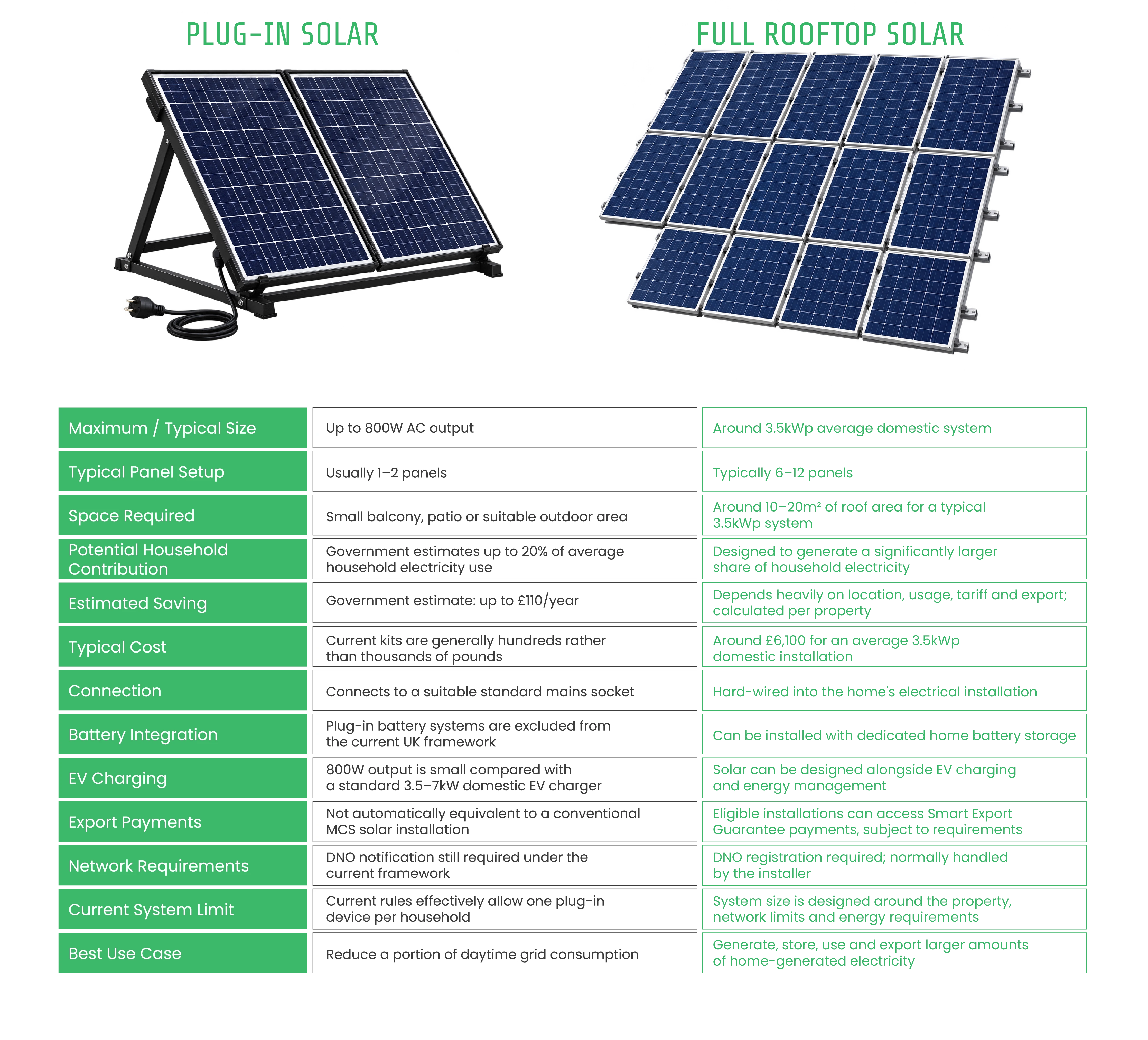
Comparison | Plug-In Solar | Full Rooftop Solar |
|---|---|---|
Maximum / Typical Size | Up to 800W AC output | Around 3.5kWp average domestic system |
Typical Panel Setup | Usually 1–2 panels | Typically 6–12 panels |
Space Required | Small balcony, patio or suitable outdoor area | Around 10–20m² of roof area for a typical 3.5kWp system |
Potential Household Contribution | Government estimates up to 20% of average household electricity use | Designed to generate a significantly larger share of household electricity |
Estimated Saving | Government estimate: up to £110/year | Depends heavily on location, usage, tariff and export; calculated per property |
Typical Cost | Current kits are generally hundreds rather than thousands of pounds | Around £6,100 for an average 3.5kWp domestic installation |
Connection | Connects to a suitable standard mains socket | Hard-wired into the home's electrical installation |
Battery Integration | Plug-in battery systems are excluded from the current UK framework | Can be installed with dedicated home battery storage |
EV Charging | 800W output is small compared with a standard 3.5–7kW domestic EV charger | Solar can be designed alongside EV charging and energy management |
Export Payments | Not automatically equivalent to a conventional MCS solar installation | Eligible installations can access Smart Export Guarantee payments, subject to requirements |
Network Requirements | DNO notification still required under the current framework | DNO registration required; normally handled by the installer |
Current System Limit | Current rules effectively allow one plug-in device per household | System size is designed around the property, network limits and energy requirements |
Best Use Case | Reduce a portion of daytime grid consumption | Generate, store, use and export larger amounts of home-generated electricity |
And if you're thinking about several of these technologies?
This is when it becomes worth considering them together rather than one installation at a time.
Your solar array shouldn't necessarily be designed without thinking about the battery you may add later.
Your EV charger doesn't need to be considered separately from your solar.
And your future heat pump will become another part of your home's electricity demand.
Planning ahead can help ensure that the technologies you invest in are capable of working together.
Solar is changing — and that's a good thing
The arrival of plug-in solar is an interesting step for renewable energy in Britain.
It gives more households an opportunity to generate some of their own electricity and brings solar within reach of people who may not have been able to consider rooftop PV previously.
At the same time, it highlights how rapidly home energy technology is changing.
For some people, an 800W plug-in system may be all they need.
For others, solar will be the starting point for something much bigger: a home capable of generating energy, storing it, charging a vehicle, supporting electric heating and automatically managing when electricity is used.
The right question therefore isn't simply:
“Which solar panels should I buy?”
It's:
“What do I want my home's energy system to do?”
At Pro-Teck, we design renewable energy, electrical and smart-home systems around the property and the people using it — from Solar PV and battery storage to EV charging, heat pumps and complete energy management.
Thinking about solar or planning a smarter home energy system?
Speak to Pro-Teck about the right solution for your property.